Investing in Nigeria’s Capital Market: Opportunities Amid Volatility
Nigeria’s capital market continues to attract attention from both domestic and foreign investors as it displays a mix of robust opportunity and serious risk. With reform-minded policies, improving liquidity, and attractive returns, there’s plenty to like — but the volatility is real. For investors considering entering or increasing exposure in this market, understanding both the upside and the pitfalls is crucial.
The Upside: What’s Working in Nigeria
- Strong Market Returns
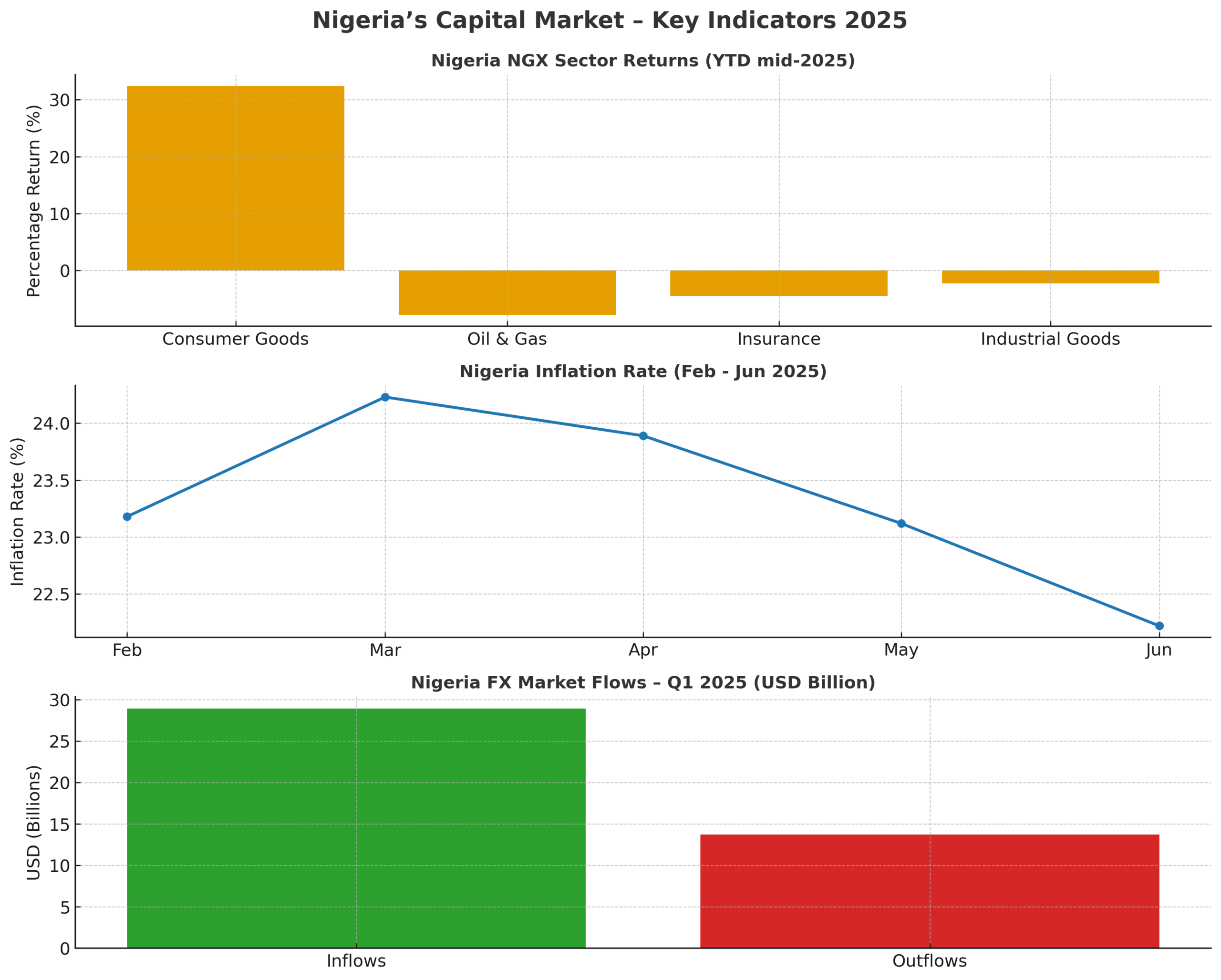
In recent years, the Nigerian Exchange (NGX) has delivered impressive gains. For example, in 2024 the market returned about 37.65%, outpacing inflation and offering real returns to investors.
In mid-2025, the year-to-date (YTD) performance also looked positive, with the All-Share Index rising significantly - Policy and Reform Tailwinds
Several macroeconomic reforms have helped restore investor confidence. Removal of fuel subsidies, liberalization of the foreign exchange (FX) market, and a tightening of monetary policy are among steps that have helped align fundamentals. These changes make the regulatory and operational environment somewhat more predictable. - Valuable Diversification for Portfolios
For investors, the Nigerian capital market offers exposure to sectors that are often underrepresented in global portfolios: consumer goods, industrials, oil & gas, banking, and telecommunications. Because global markets are sometimes overexposed to certain geographies or sectors, Nigeria can provide diversification benefits. Additionally, the potential for gains in naira-denominated assets when currency moves favorably is another incentive. - Domestic & Foreign Investor Interest Rising
There is growing activity from both local investors and foreign portfolio investors (FPIs). Investors are responding to undervalued stocks, bargains in the market, and the fact that Nigerian equities can offer higher nominal yields compared to many other emerging or frontier markets.
The Volatility: Key Risks & Headwinds
- Inflation and Currency Risk
One of the biggest challenges for Nigeria’s capital market is high inflation. When inflation is high, real returns (after adjusting for inflation) can be much lower than nominal returns. Also, fluctuations in the naira can erode gains when converting back to hard currencies, especially for foreign investors. - Interest Rates and Monetary Policy Uncertainty
The Central Bank of Nigeria (CBN) has had to maintain high monetary policy rates to tackle inflation. High interest rates tend to make fixed income (bonds, treasury bills) more attractive compared to equities, which could shift investor preference away from stocks during tightening cycles. - Regulatory and Policy Risks
Unexpected policy shifts (tax changes, subsidy removals, regulation of certain sectors) create uncertainty. While reforms are broadly positive, inconsistency in implementation or sudden changes can spook the market. There is also risk around corporate governance, transparency, and regulatory enforcement. - Liquidity & Foreign Capital Flows
Liquidity in some stocks is low, making it hard to enter or exit positions without significant price impact. Also, foreign capital can be fickle: global events (like rising rates in developed markets), changes in risk perception, or currency instability can prompt rapid outflows. Such swings amplify volatility.
Strategies for Investors: Navigating the Ups & Downs
If you’re considering investing, here are some strategies for reducing risk and capturing upside:
- Diversification: Spread investments across sectors (financials, industrials, consumer, oil & gas) and across asset types (equities + fixed income) to smooth returns.
- Long-Term Horizon: Riding out short-term volatility demands patience. Many of the strong returns have been over 12- to 24-month periods.
- Focus on Quality & Blue-Chip Firms: Companies with strong fundamentals, good governance, and earnings resilience tend to weather storms better.
- Monitor Policy & Macro Indicators: Follow inflation trends, FX policy, interest rates, and government policy announcements. They tend to drive major stock market moves.
- Hedging & Currency Considerations: If you’re exposed to the naira, look for ways to hedge (if possible) or ensure that the potential return compensates for currency risk.
Investing in Nigeria’s capital market right now offers an attractive risk-return profile for investors who can handle volatility. While risks from inflation, currency depreciation, and policy shifts are real, the combination of strong returns, improving reforms, and undervalued assets make it a compelling frontier market play.
For those who enter with eyes open — armed with research, diversified portfolios, and a long-term focus — the opportunities may well outweigh the risks.
-
Food and Beverages West Africa Exhibition Set for Landmark Event Centre This June
Leading industry players, manufacturers, and investors to converge in Lagos for a three-day showcase of innovation, networking, and growth opportunities in West Africa’s food and beverage sector. By Uche Ikebudu LAGOS, NIGERIA — The highly anticipated Food and Beverages West Africa (FAB West Africa) Exhibition is set to take place this June at the Landmark…
-
Interview: Naira Stability May be Tested By Global Oil Crisis.
Mr Bolaji Soneye By Uche Vera In this Interview, Mr Bolaji Soneye, the Managing Director of Flotrade, a Lagos Based Foreign Exchange Firm talks on the unification of the Naira and how it has emerged as one of the biggest drivers of the Naira performance. He also spoke on the war in Iran and how…
-
Customs to End Routine Physical Cargo Inspection By December.
By Uche Ikebudu Nigeria’s customs authorities have announced plans to phase out routine physical inspections of cargo at ports across the country by December, a move aimed at modernising clearance processes and reducing delays in the movement of goods. The decision was disclosed by the Comptroller-General of the Nigeria Customs Service, Bashir Adewale Adeniyi, during…
-
Agiville Industries Limited: Quality Assurance, Innovation and Customer Satisfaction are the Pillars of the Agiville Brand
By Uche Ikebudu Agiville Industries Limited is a proudly Nigerian manufacturing company committed to delivering high-quality plastic products that support environmental sanitation, sustainable living, and everyday convenience. Over the years, the company has built a strong reputation as a reliable producer of durable waste management solutions and plastic furniture designed to meet the needs of…
-
Mallam Kasimu Garba Kurfi, The MD of APT Securities and Funds Limited Talks on the GDP Growth, Economic Reforms, MPR Among Other Issues
Mallam Kasimu Garba Kurfi, MD, APT Securities and Funds Limited. By Uche Ikebudu Q: The GDP growth increased by 4.07 percent in Q4 2025. And Q2 2025, the GDP grew by 4.23 percent. This is the highest GDP growth in 10 years.What’s your take on the GDP growth trend and the economic reform policies of…
-
World Bank MD Hails Nigeria as Global Reference Point for Steady, Credible Reforms
Anna Bjerde, World Bank MD By Uche Vera ABUJA — Nigeria has become a frequent global reference point for steady and credible reform leadership, according to Anna Bjerde, the Managing Director (MD) for Operations at the World Bank. Bjerde made the statement on Tuesday during a visit to the State House in Abuja, where she…