By Uche Vera
After two difficult years marked by soaring prices and sharp policy adjustments, 2025 is shaping up to be a year of cautious relief for Nigerians. Recent figures released by the National Bureau of Statistics (NBS) show a clear moderation in the inflation rate compared to the highs recorded in 2023 and 2024. While inflation remains elevated by global standards, the direction of movement — downward — is significant for an economy that has endured prolonged hardship.
.
- Inflation Is Cooling — Slowly but Consistently*
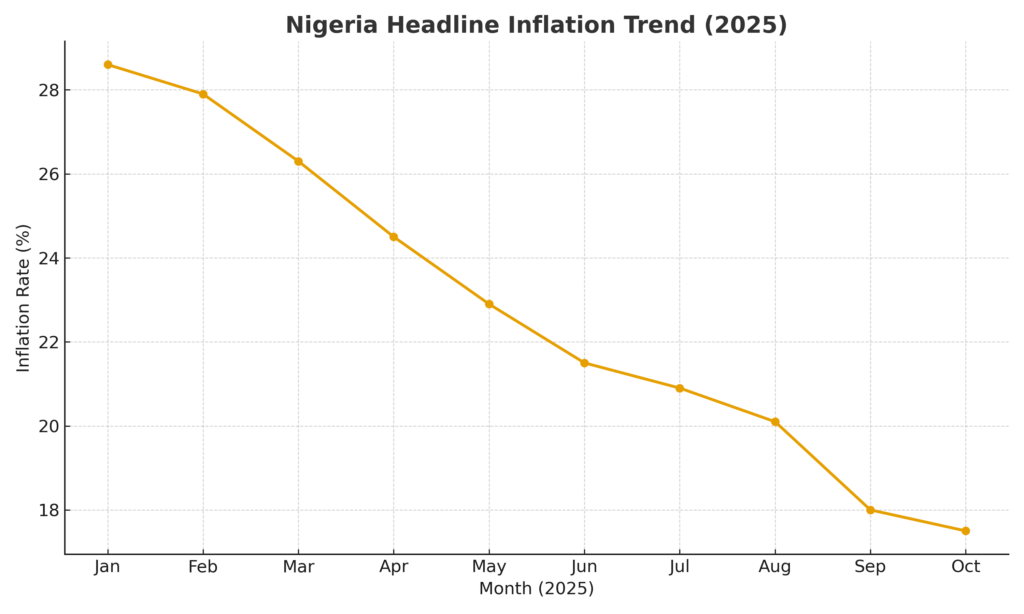
Although monthly figures vary, NBS data throughout 2025 show a steady deceleration in headline inflation, driven largely by improvements in food supply, better FX market stability, and the gradual pass-through of earlier policy reforms. Food inflation — historically the most painful component — has also begun easing as harvests improve and logistics disruptions reduce.
This pattern suggests not a temporary dip but a sustained disinflation trend. Nigerians who follow NBS monthly reports would notice a repeating pattern: each month brings a marginal decline — not dramatic, but consistent.
For consumers, this means prices are still rising, but at a slower pace. A bag of rice or a litre of vegetable oil may not drop in price overnight, but the sharp, frightening jumps of the previous two years have clearly reduced.
- Why This Is Happening — The Real Drivers Behind the Trend
A combination of factors is behind the inflation cooldown:
a. Policy tightening by the CBN
The Central Bank of Nigeria (CBN) maintained a tight monetary policy stance through 2023 and 2024, raising benchmark interest rates repeatedly. The goal was simple: reduce inflation by slowing demand and stabilising the naira.
By 2025, the effect is showing.
Higher interest rates:
- reduced speculative FX pressure
- encouraged inflows into fixed-income instruments
- strengthened the naira
- slowed price pass-through from imports
With the exchange rate more stable, imported goods — from raw materials to everyday consumer items — exert less upward pressure on prices.
b. Improved agricultural output
Late-2024 and early-2025 harvests were stronger in many states, helping calm food inflation — the area where Nigerians feel inflation most deeply. Better rainfall patterns, gradual improvements in security across some farming belts, and more investment in domestic crop production also helped
c. Easing of supply bottlenecks*
The early chaos that followed subsidy removal, FX unification, and reform shocks has somewhat stabilised. Transport costs, diesel prices, and logistics disruptions are not as extreme as they were in 2023–2024.
All these factors combine to soften inflationary pressure.
- What This Means for Ordinary Nigerians
From the viewpoint of the average Nigerian, inflation slowing does not mean prices are falling. What it means is:
- price increases are less steep
- salaries stretch a little further
- households can plan better
- panic buying reduces
- traders face fewer unpredictable cost swings
For families that survived the worst inflation in decades, even incremental relief matters.
- Abducted Oyo Pupils, Teachers Rescued After 56 Days in Captivity
- First Batch of Evacuated Nigerians Arrive Home from South Africa Amid Xenophobic Tensions
- Food and Beverages West Africa Exhibition Set for Landmark Event Centre This June
- Interview: Naira Stability May be Tested By Global Oil Crisis.
- Customs to End Routine Physical Cargo Inspection By December.
However, real incomes remain under strain. Many employers have not adjusted salaries to match the high-inflation years, and living costs remain significantly above 2021–2022 levels. So while inflation is slowing, life is still tough, and recovery will feel gradual.
- What It Means for Businesses
Businesses — especially SMEs — are entering a more predictable environment.
- Importers can price goods more confidently.
- Manufacturers face fewer cost spikes from FX volatility.
- Retailers can stock inventories without fear of sudden losses.
- Banks may begin adjusting lending rates if CBN eventually softens its tightening stance.
However, access to credit remains expensive, and many businesses are still recovering from the shockwaves of previous years. The growth outlook is improving, but cautiously.
- What to Expect for the Rest of 2025*
From an editorial standpoint, the key question is whether this trend lasts. Based on NBS data patterns and CBN signalling, several scenarios emerge:
Positive indicators
- Continued stability in the FX market
- Better agricultural performance
- Lower imported inflation
- Improved policy coordination
Risks
- Fuel price adjustments
- Persistent insecurity in food-producing regions
- Global commodity price spikes
- Fiscal slippages at federal or state level
If the positive forces continue to outweigh the risks, Nigeria could end 2025 with inflation approaching the mid-teen range — still high, but far gentler than the crisis levels seen recently.
Nigeria’s inflation story in 2025 is one of slow but real improvement. NBS data backs it. CBN policy supports it. And Nigerians are beginning to feel it — not as cheaper prices, but as fewer shocks.
For a nation still healing from intense economic pressure, the current trend offers a rare commodity: relief. The challenge now is sustaining it with discipline, better governance, and continued reforms.
If Nigeria stays on this path, 2025 may be remembered as the year inflation finally turned a corner — and the economy began the long walk back to stability.
-
Abducted Oyo Pupils, Teachers Rescued After 56 Days in Captivity
Rescued Oyo Pupils and Teachers The abducted Oyo pupils and teachers have been rescued after 56 days in captivity following a coordinated security operation involving the military and other security agencies. By Uche Ikebudu The pupils and teachers abducted from three schools in Oriire Local Government Area of Oyo State have regained their freedom after…
-
First Batch of Evacuated Nigerians Arrive Home from South Africa Amid Xenophobic Tensions
Hundreds of Nigerians return to Lagos as the Federal Government begins phased evacuation efforts following attacks on foreign nationals in South Africa. By Uche Ikebudu. Friday June 12, 2026 The evacuation of Nigerian citizens from South Africa gathered momentum on Wednesday as the first batch of returnees arrived in Nigeria following weeks of tension and…
-
Food and Beverages West Africa Exhibition Set for Landmark Event Centre This June
Leading industry players, manufacturers, and investors to converge in Lagos for a three-day showcase of innovation, networking, and growth opportunities in West Africa’s food and beverage sector. By Uche Ikebudu LAGOS, NIGERIA — The highly anticipated Food and Beverages West Africa (FAB West Africa) Exhibition is set to take place this June at the Landmark…
-
Interview: Naira Stability May be Tested By Global Oil Crisis.
Mr Bolaji Soneye By Uche Vera In this Interview, Mr Bolaji Soneye, the Managing Director of Flotrade, a Lagos Based Foreign Exchange Firm talks on the unification of the Naira and how it has emerged as one of the biggest drivers of the Naira performance. He also spoke on the war in Iran and how…
-
Customs to End Routine Physical Cargo Inspection By December.
By Uche Ikebudu Nigeria’s customs authorities have announced plans to phase out routine physical inspections of cargo at ports across the country by December, a move aimed at modernising clearance processes and reducing delays in the movement of goods. The decision was disclosed by the Comptroller-General of the Nigeria Customs Service, Bashir Adewale Adeniyi, during…
-
Mallam Kasimu Garba Kurfi, The MD of APT Securities and Funds Limited Talks on the GDP Growth, Economic Reforms, MPR Among Other Issues
Mallam Kasimu Garba Kurfi, MD, APT Securities and Funds Limited. By Uche Ikebudu Q: The GDP growth increased by 4.07 percent in Q4 2025. And Q2 2025, the GDP grew by 4.23 percent. This is the highest GDP growth in 10 years.What’s your take on the GDP growth trend and the economic reform policies of…