Non-oil sectors and services drive Nigeria’s gradual economic recovery amid cautious growth and structural reforms.
By Olukemi Odoh
From November 2024 through November 2025, the economy has shown a steady but cautious recovery, according to data from the National Bureau of Statistics (NBS). A combination of structural reforms, rebasing of GDP, and a rebound in both non-oil and oil sectors has underpinned this trend, with the services and industrial sectors playing central roles.
Economic Upturn From Year End 2024
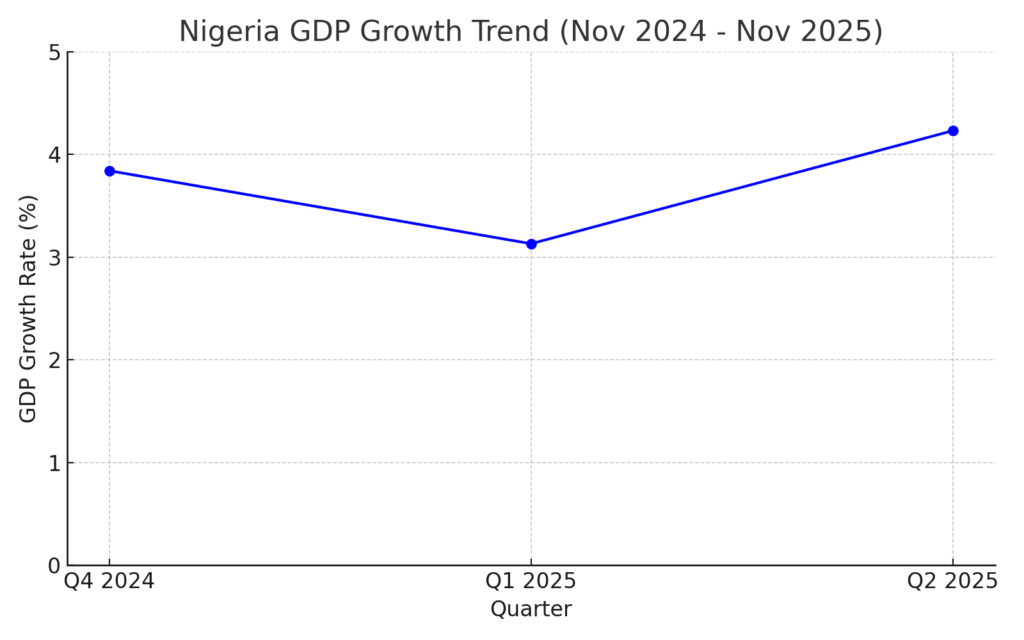
In the final quarter of 2024, Nigeria recorded a real gross domestic product (GDP) growth rate of about 3.84 percent year-on-year. This represented a modest acceleration over the 3.46 percent growth posted in the third quarter of 2024. The NBS report identified the services sector as the primary growth engine, expanding by around 5.37 percent and contributing more than half of overall GDP.
Meanwhile, agriculture grew at a slower pace of about 1.76 percent, down from 2.10 percent in the same quarter a year earlier. The industry sector also slowed, registering only around 2.00 percent growth versus about 3.86 percent in the last quarter of the previous year.
Importantly, non-oil activities dominated this quarter’s performance: the non-oil sector grew at roughly 3.96 percent and accounted for more than 95 percent of total GDP. On the oil side, average daily crude production stood at about 1.54 million barrels per day, while the oil-sector real GDP grew by just around 1.48 percent — significantly lower than growth rates in earlier periods.
Across the full year of 2024, Nigeria’s economy expanded by approximately 3.40 percent, up from around 2.74 percent in 2023.
- Abducted Oyo Pupils, Teachers Rescued After 56 Days in Captivity
- First Batch of Evacuated Nigerians Arrive Home from South Africa Amid Xenophobic Tensions
- Food and Beverages West Africa Exhibition Set for Landmark Event Centre This June
- Interview: Naira Stability May be Tested By Global Oil Crisis.
- Customs to End Routine Physical Cargo Inspection By December.
Transition: GDP Rebasing and Q1 2025
A significant milestone in early 2025 was the rebasing of Nigeria’s GDP to a 2019 base year, a move by the NBS to better reflect the evolving structure of the economy. The rebasing brought in previously undercounted sectors such as marine, tourism, arts, culture, and e-commerce.
Under the rebased series, real GDP growth in the first quarter of 2025 stood at about 3.13 percent year-on-year. The services sector again played a leading role, growing by roughly 4.33 percent and contributing more than half of total GDP. The industry sector posted solid gains, expanding by approximately 3.42 percent, while agriculture made barely noticeable progress, growing by only about 0.07 percent, recovering from a contraction in earlier data.
On the oil side, real growth was about 1.87 percent, but the oil sector’s share of GDP fell to under 4 percent, reinforcing the dominant role of non-oil activities in economic output.
Nominal GDP also rose strongly in Q1 2025, reaching nearly — a sizable increase compared to the same period in 2024.
Strong Momentum in Q2 2025
Quarter two of 2025 delivered the strongest growth in over a year, with GDP expanding by approximately 4.23 percent year-on-year.
A breakdown by sector showed the industry as the standout performer, growing by an estimated 7.45 percent, a substantial acceleration compared to the same quarter the year before. The services sector also ticked up, expanding by about 3.94 percent, slightly ahead of its growth in Q2 2024. Agriculture maintained steady expansion, growing by around 2.82 percent, improving on the prior year’s figure.
In terms of contribution to GDP, industry took a larger share, accounting for about 17.3 percent in Q2, up from around 16.8 percent a year earlier. Meanwhile, the oil sector’s share of GDP remained low, at just over 4 percent, while non-oil activities held almost 96 percent.
Underlying Drivers and Risks
The improved growth trajectory between November 2024 and mid-2025 reflects several key dynamics:
- Rebasing Effects: Updating the GDP base year to 2019 widened the economic base and more accurately captured contributions from fast-growing sectors, improving the quality of statistical measures.
- Industrial Surge: The strong growth in the industrial sector in Q2 2025 suggests increasing investments in manufacturing, construction, and other key industrial activities, indicating a potential structural shift in the economy.
- Service Sector Resilience: Services remain the backbone of growth, with sectors such as telecommunications, finance, transport, and business services driving consistent demand.
- Non-Oil Dominance: A continued shift toward non-oil activities provides resilience against fluctuations in global commodity prices and reduces dependence on crude.
- Fragile Oil Recovery: Although oil output recovered somewhat, growth in the oil sector remains subdued, and any external shock could reverse gains.
On the risk front, inflation—especially in food prices—continues to drag on consumer spending. Exchange rate volatility, high interest rates, and fiscal constraints pose significant headwinds to private investment. Also, while rebasing gives a more realistic picture of economic structure, it may obscure underlying inefficiencies, particularly in agriculture and in the informal service landscape.
Outlook Toward November 2025
As of November 2025, Nigeria’s GDP trend points to a gradual but promising economic recovery anchored by stronger non-oil performance. The economy appears more diversified, with industry and services pulling more weight in total output. Non-oil activities remain the engine of growth, reducing the economy’s vulnerability to external oil shocks.
If momentum in industry and services is sustained, and if policymakers can curb inflation and stabilize public finances, Nigeria may continue consolidating gains in the latter half of 2025. But sustained growth will demand more than statistical reclassification: deep investments in infrastructure, reforms to boost productivity, and policies that strengthen agriculture and promote formalization will be critical.
Overall, the NBS data paints the picture of an economy navigating a transition — moving away from its traditional oil dependence, but still balancing the legacy challenges of infrastructure deficits, weak agricultural productivity, and external vulnerabilities.
-
Abducted Oyo Pupils, Teachers Rescued After 56 Days in Captivity
Rescued Oyo Pupils and Teachers The abducted Oyo pupils and teachers have been rescued after 56 days in captivity following a coordinated security operation involving the military and other security agencies. By Uche Ikebudu The pupils and teachers abducted from three schools in Oriire Local Government Area of Oyo State have regained their freedom after…
-
First Batch of Evacuated Nigerians Arrive Home from South Africa Amid Xenophobic Tensions
Hundreds of Nigerians return to Lagos as the Federal Government begins phased evacuation efforts following attacks on foreign nationals in South Africa. By Uche Ikebudu. Friday June 12, 2026 The evacuation of Nigerian citizens from South Africa gathered momentum on Wednesday as the first batch of returnees arrived in Nigeria following weeks of tension and…
-
Food and Beverages West Africa Exhibition Set for Landmark Event Centre This June
Leading industry players, manufacturers, and investors to converge in Lagos for a three-day showcase of innovation, networking, and growth opportunities in West Africa’s food and beverage sector. By Uche Ikebudu LAGOS, NIGERIA — The highly anticipated Food and Beverages West Africa (FAB West Africa) Exhibition is set to take place this June at the Landmark…
-
Interview: Naira Stability May be Tested By Global Oil Crisis.
Mr Bolaji Soneye By Uche Vera In this Interview, Mr Bolaji Soneye, the Managing Director of Flotrade, a Lagos Based Foreign Exchange Firm talks on the unification of the Naira and how it has emerged as one of the biggest drivers of the Naira performance. He also spoke on the war in Iran and how…
-
Customs to End Routine Physical Cargo Inspection By December.
By Uche Ikebudu Nigeria’s customs authorities have announced plans to phase out routine physical inspections of cargo at ports across the country by December, a move aimed at modernising clearance processes and reducing delays in the movement of goods. The decision was disclosed by the Comptroller-General of the Nigeria Customs Service, Bashir Adewale Adeniyi, during…
-
Mallam Kasimu Garba Kurfi, The MD of APT Securities and Funds Limited Talks on the GDP Growth, Economic Reforms, MPR Among Other Issues
Mallam Kasimu Garba Kurfi, MD, APT Securities and Funds Limited. By Uche Ikebudu Q: The GDP growth increased by 4.07 percent in Q4 2025. And Q2 2025, the GDP grew by 4.23 percent. This is the highest GDP growth in 10 years.What’s your take on the GDP growth trend and the economic reform policies of…